- Decoherence
- Noise
- Neutral Atom Quantum Computer & Rydberg Atoms [1], [2]
- The Need for Quantum Error Correction
- Sources
1. Decoherence
Quantum states are very easily damaged by uncontrolled interactions with the environment
In addition, a quantum state decays from a higher energy state |1> to the ground state |0> := coherence time, i.e. how long is a quantum state stable?
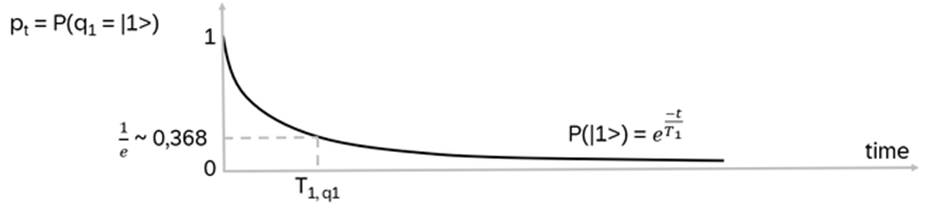
T1 describes ‘how long does a qubit stay close to |1>‘
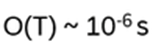
– this is, why we never see macroscopic superposition, like a dead cat which is alive 😊
The coherence time must be much longer than the (quantum) gate operation time. Since decoherence cannot be avoided: fault tolerance and error correction is unavoidable!
Some other error sources:
- Ability to initialize qubits reliable
- Reliable measurement capability (e.g. for the ancilla qubits, see the stabilizer blog)
2. Noise
Noise corresponds to a phase coherence time, e.g. in the xy-plane of the Bloch sphere:

But in reality: after the Hadamar Gate, there will be drifting in the xy-plane by some small φ and hence it is not exactly the orthogonal basis state anymore!
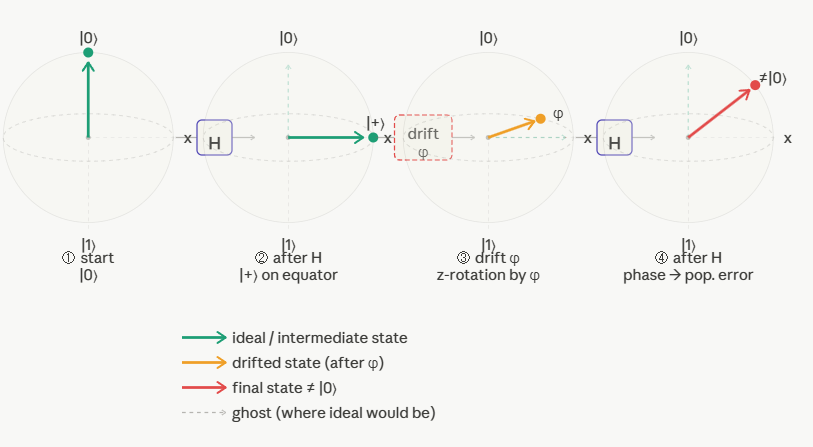
Note: Noise is not a unitary transformation,

Noise is superpositioning decoherence!
3. Neutral Atom Quantum Computer & Rydberg Atoms [1], [2]
There are various architectures to build a quantum computer, none currently able to support the quantum advantage on a broader scale (due to scaling and stabilitiy issues, resulting in a very short available computational time). Here an approach followed e.g. by Atom Computing is looked into, using neutral atoms trapped with highly focused laser beams (in contrast, IBM is using tiny superconducting circuits to realize qubits, see e.g. [3])
In general, DiVincenzo’s criteria describe a guideline for building a quantum computer [4]:
- Well-characterized and scalable qubits
- Qubit initialization
- Long coherence times
- Universal set of gates to perform operations on qubits
- Measurement of individual qubits
Optical tweezers can trap a neutral atom (essentially because on very small scales the atom is not really neutral, and a laser beam is an electromagnetic wave, i.e. oscillating electric and magnetic fields, interacting with the electrons of the ‘neutral’ atom)
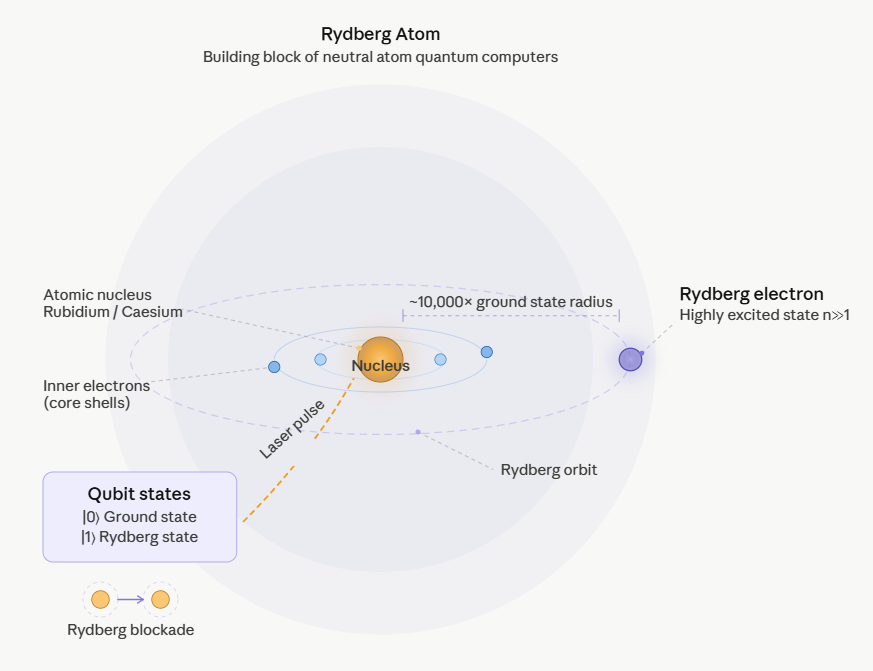
Rydberg atoms have large electrical dipole moments compared to ground state atoms and hence strong interactions with external fields (macroscopic) or electromagnetic fields from nearby particles (microscopic) [5]. These interactions can be controlled e.g. by lasers or microwaves, making neutral Rydberg atoms a reasonable choice for qubit-registers. In a circular Rydberg atom, the excited electron follows a (large) circular path around the atomic nucleus, leading to a longer lifetime. Strontium is an example: τ0 = 2,55 ms (T1 from before) at room temperature, [6]!
To encode a qubit in a neutral atom, one needs to have access to two distinct atomic quantum states, hence try to switch a single electron between energy states. Ideal are atoms with one valence electron (for more details on atom’s energy levels and electrons see e.g. [7]).
Having chosen one electron in the atom it has to be ensured, that only two energy levels are in play forming a qubit! One of the energy levels will be a ground state for the valence electron, called fiducial state, denoted by |0>. The other energy level will be a long-living excited state, called the hyperfine state, denoted |1>. The transition between those to energy levels will be induced by light whose energy is exactly the energy difference between these two atomic levels.
Now DiVincenzo’s second criteria: all qubits of a register need to be initialized to the fiducial ground state. This state is stable, since minimal-energy states will not spontaneously emit any energy. For Rb-85 atoms this can be achieved by laser cooling, see [8], Nobel Price in Physics 1997. Rb-85, because it has only one valence electron and in addition two (degenerated, same minimal energy level) ground states |0> and |0’> which can be excited to |1> and |1’>. But from both excited states the prefered fall back is |0>, the fiducial ground state. Together with optical tweezers so focused to allow at most a single atom trapped, the RB-85 atoms can be initialized and arranged as needed.
There are two additional issues: the trap has at most one atom, so some are empty, and laser cooling incorporates probabilities, so not all Rb-85 are in the |0> state. By exciting the atoms with photons having exact the right energy to bring the Rb-85 atoms to some short-lived excited state, the resulting decay to |0> will emit photons identifying the atoms in |0>
To do computations, the energy levels (quantum states) involving the valence electron needs to be controlled over time. This is achieved by short light pulses with specific amplitudes and phases. Not going into mathematical details, the observable energy levels as the quantum state’s evolvement in time is described by the Hamiltonian H of the system, see e.g. [7].
( In general Schrödinger’s equation looks like

which looks a lot easier then it is …😊)
It can be shown, [9]: the Blackman window pulse is appropriate to be applied to all the Rb-85 atoms in the array in question.
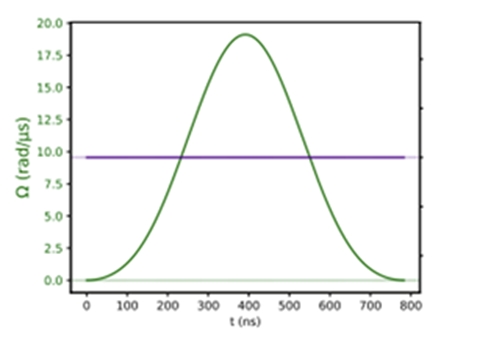
It turns out: e.g. the one-qubit rotation gate

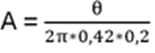
can be realized by a Blackman pulse of amplitude
Analogously: Ry
What about two-qubit gates, adding qubit interactions? Although the atoms are neutral, Van der Waals interactions will occur on small scales between (Rydberg) atoms. Define next to the ground state the second used (high energy) quantum state of a Rydberg atom as Rydberg state |r>. If two atoms are ‘far’ away two energy pulses can lead to |00> -> |0r> -> |rr>. But when the distance becomes too small, only |0r> or |r0> can occur. This is called the Rydberg blockade. But because of this blockade, the quantum gate

can be defined, providing together with the other two a universal set of gates
The Rz gate can be realized with two atoms (control and target), the Rydberg blockade and the following three pulses in this specific order:
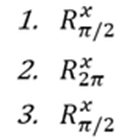
This leads to
- |00> -> -|00>
|00>: The first π pulse brings |00> -> |r0>, the 2π pulse (target qubit) to |rr> and further to |r0> again is suppressed because of the blockade and the second π pulse rotates the control qubit further to its original state; all following transitions: the π and 2π pulses do not correspond to the energy level of |1> -> |r>
- |01> -> -|01>
- |01> -> -|01>
- |11> -> |11>
Up to a global phase, this is the Rz gate!
But in practice: It is not easy to address single atoms with laser pulses. In addition: decoherence times and external interactions (no perfect vacuum) destroys the arranged quantum states (the Rydberg states) very quickly, leading as mentioned to issues regarding scalability and computational time
Hence Quantum Error Correction …
4. The Need for Quantum Error Correction
Possible ‘spontaneous’ errors:
- Bit flip: a|0> + b|1> -> b|0> + a|1> (on purpose: X-gate)
- Phase error (with no classical counterpart): a|0> + b|1> -> a|0> – b|1> (Z-gate)
Since there is the no cloning theorem of quantum states, e.g. [10], and hence no classical storage (RAM-) duplicating is possible, another approach is necessary. Based on entanglement, this is QEC (Quantum Error Correction)
A logical qubit is an abstract, error-protected qubit that is encoded across many physical qubits. Spreading information across several physical qubits by entanglement, errors can be detected and corrected, [11]
Correct any single qubit error (flip and/or phase): 9 qubit Shor code (see the corresponding blog)
I.e. in general, for n stable and corrected (logical) qubits, 9n physical qubits are needed
But with this approach: to correct errors of qubits, one needs more qubits, and then more qubits to correct the error-correcting qubits! Nevertheless, one can calculate a threshold [12] (and the following blogs on the surface code)
5. Sources
- [1] ‚Neutral-atom quantum computer‘ by Alvaro Ballon, 2023 (pennylane.ai/qml/demos/tutorial_neutral_atoms)
- [2] ‚Quantum Computing With Neutral Atoms‘ by Henriet et al., 2020 (arxiv.org/pdf/2006.12326)
- [3] ‚A Quantum Engineer’s Guide To Superconducting Qubits‘ by Krantz et al., 2021 (arxiv.org/pdf/1904.06560)
- [4] ‚The Physical Implementation of Quantum Computation‘ by DiVincenzo, 2000 (arxiv.org/pdf/quant-ph/0002077)
- [5] ‚A concise review of Rydberg atom based quantum computation and quantum simulation‘ by Wu et al., 2021 (arxiv.org/pdf/2012.10614)
- [6] ‚Long-Lived Circular Rydberg Qubits of Alkaline-Earth Atoms in Optical Tweezers‘ by Hölzl et al., 2024 (journals.aps.org/prx/abstract/10.1103/PhysRevX.14.021024)
- [7] Vorlesungen über Physik, Band III: Quantenmechanik, Feynman/Leighton/Sands, Oldenbourg, 2.Aufl. 1992
- [8] ‚Laser Cooling and Trapping of Neutral Atoms‘ by Phillips, 1997 (nobelprize.org/uploads/2018/06/phillips-lecture.pdf)
- [9] ‚Pulser: An open-source package for the design of pulse sequences in programmable neutral-atom arrays‘ by Silvério et al., 2022 (arxiv.org/pdf/2104.15044)
- [10] ‚Limitations on quantum information‘ by IBM Learning (quantum.cloud.ibm.com/learning/en/courses/basics-of-quantum-information/quantum-circuits/limitations-on-quantum-information)
- [11] ‚The Rise of Logical Qubits: How Quantum Computers Fight Errors‘ by Ivezic, 2025 (postquantum.com/quantum-computing/logical-qubits/)
- [12] ‚Suppressing quantum errors by scaling a surface code logical qubit‘ by Google Quantum AI, 2022 (arxiv.org/pdf/2207.06431)
Schreibe einen Kommentar