- Introduction
- Double Split Experiment
- RSA, Shors Algorithm and Secrets
- Mathematical & Quantum Physics Preliminaries
- Some Properties of Complex Numbers
- Linear Transformations and (Unitary) Matrices
- Some Geometry
- Some Group Theory
- Eigenvalues and Eigenvectors
- Tensorproducts
- Root of Unity & Summation Formula
- One Qubit
- Bloch Sphere
- Bra and Kets
- Quantum State of a Qubit
- Observables and Expectations
- Quantum Gates
- Two Qubits
- Entanglement
- Multi-Qubit Gates: The Quantum H⨂ n Gate
- The Quantum CNOT/CX Gate
- Circuits
- Simple Circuits
- Amplitude Maximization & Interference
- Inversion About The Mean
- Sources
1. Introduction
Note: most of the pictures are generated with Claude.ai
Double Split Experiment – The Importance of Measurement
Wave-particle-duality of light: if not measured through which split the photon is travelling, it behaves like waves, i.e. the interference pattern looks like
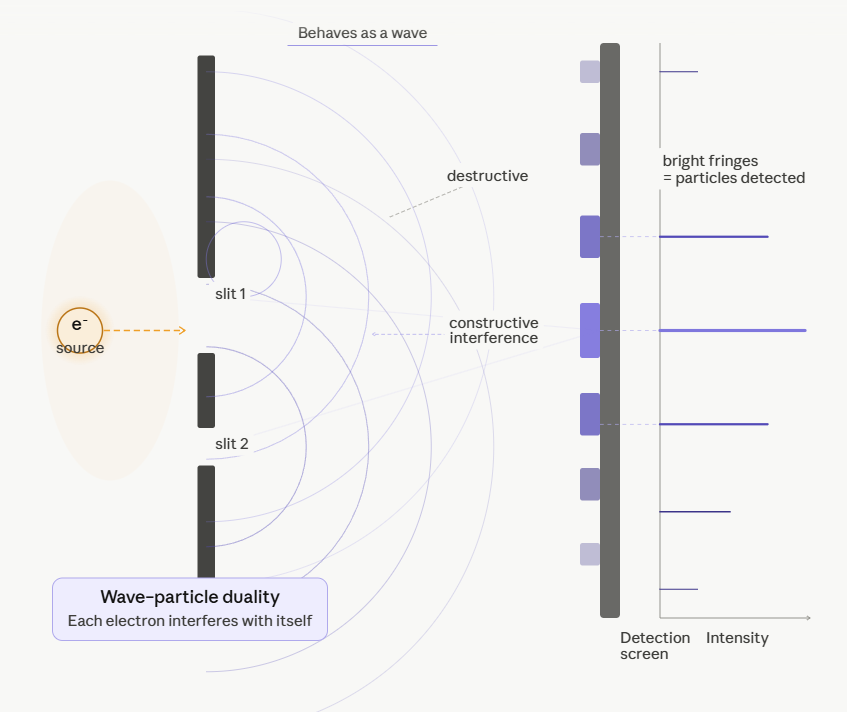
But if looked up, it behaves like a particle!
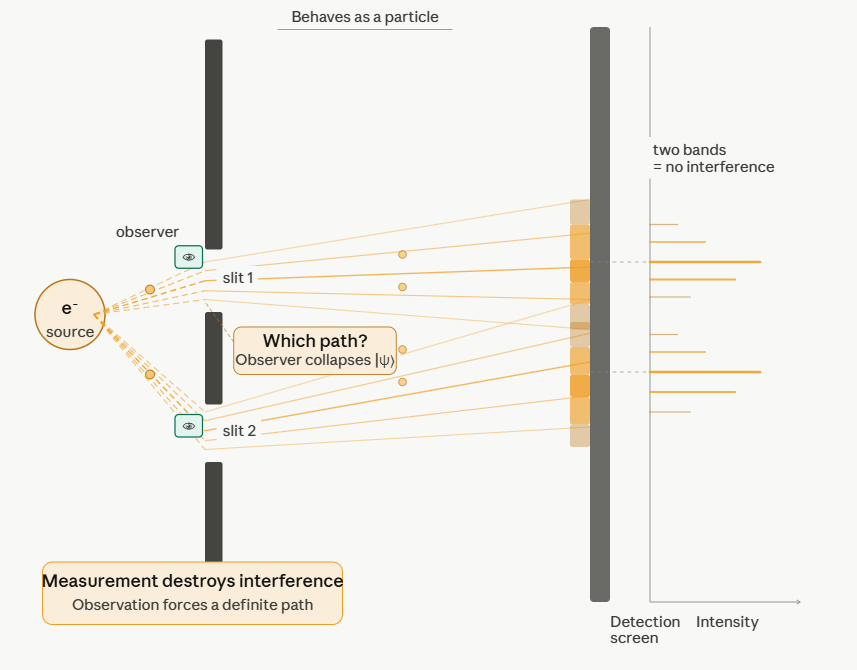
In general: on a very small scale, the world behaves not very intuitive …. (Quantum Mechanics, Quantum Electrodynamics (Photons), Quantum Chromodynamics (Quarks), Supersymmetric String Theory, Quantum Groups, …)
RSA, Shors Algorithm and Secrets
‘Polynomial-Time Algorithms for Prime Factorization and Discrete Logarithms on a Quantum Computer’ by Peter Shor, 1994, [1]
The described quantum algorithm can ‘efficiently’ factor large integers – something classical computer struggle with
Many of todays encryption systems, including RSA (Rivest–Shamir–Adleman), rely on the difficulty of integer factorization.
‘Harvest now, decrypt later’ (HNDL), see e.g. a whitepaper from Mastercard(!) from 2025: ‘Migration to post quantum cryptography – white paper’, [2]
On a more general note: when do quantum algorithms start to outperform classical ones? See e.g. [3]
2. Mathematical & Quantum Physics Preliminaries
This is by no means a thoroughly introduction into the topics, more a mentioning what will be needed
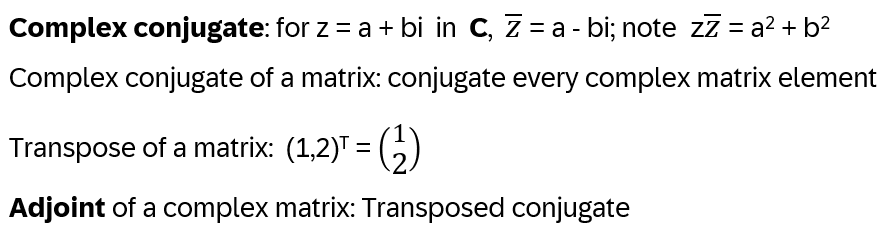
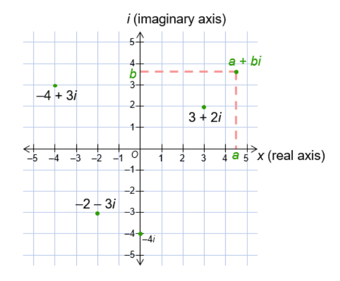
a) Some Properties of Complex Numbers
b) Linear Transformations and (Unitary) Matrices, [4]
• Let Un and Vm be vector spaces over R of dimension n, m respectively. Let u1 and u2 be in U and s1 and s2 in R. The function L: U -> V is a linear map if L(u1 + u2) = L(u1) + L(u2) and L(s1u1) = s1L(u1). When U = V, L is called a linear transformation of U
• Assume L(u1) = Au1, where A is a n x m matrix: L(u1+u2) = A(u1+u2) = Au1 + Au2 and L(s1u1) = A(s1u1) = s1Au1, hence the matrix A is a linear transformation
•What are the characteristics of linear transformations that preserve the length, i.e. ||Lv|| = ||v||? They are unitary:
A complex square matrix U is unitary if
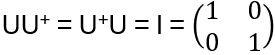
with the adjoint matrix

Remark: The matrices corresponding to gates/operations on qubits are all unitary! Examples: Pauli matrices

c) Some Geometry
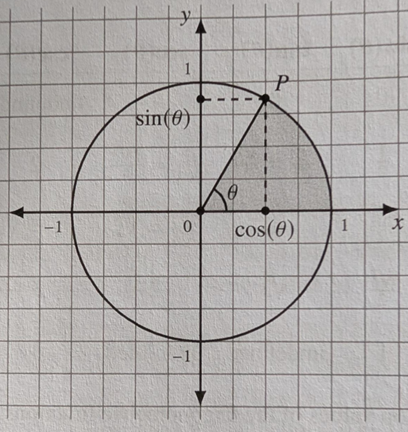
Polar coordinates: P = r cos(θ) + r sin (θ)
Eulers formula in C: z = r cos (θ) + r sin(θ) = r eθi , 0 ≤ θ < 2π
Also: z = r e2πφi , 0 ≤ φ < 1
Binary form: (used later as approximation of φ)
Base 10: 1/4 + 1/8 = 0.37510
In base 2: 0 x 2-1 + 1 x 2-2 + 1 x 2-3 = .0112
Another example: 0.2 has no exact finite binary expansion, but repeating decimals:
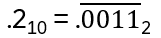
Note: a base 10 rational number has either a finite binary expansion or repeats in blocks, with the repeating block being a base 10 rational number In general: φ ≈ b12-1 + … + bm2-m =: (0.b1b2..bm)2 , hence

d) Some* Group Theory
A collection of objects or transformations with an operation * is called a group if it holds
• Closure
• Associativity
• Unique identity element
• For every object in G exists a unique inverse
If in addition a*b = b*a, G is a commutative or abelian group
Examples: (R,+) is an abelian group, (N,+) is not. Often symmetry operations form a group (e.g. the Bloch sphere representation of quantum states, see later)
*Some more: the (finite) monster ( https://plus.maths.org/content/enormous-theorem-classification-finite-simple-groups ) in the moonshine 😊 ( https://www.quantamagazine.org/mathematicians-chase-moonshine-string-theory-connections-20150312/ )
e) Eigenvalues and Eigenvectors [5]
nxn matrix A: if Av = λv, v is an eigenvector of A and λ the corresponding eigenvalue; (A – λ I) v = 0 and since v ≠ 0: (A – λ I) not invertible and hence det (A – λ I) = 0

hence 1 and -1 are eigenvalues. This generalizes to any diagonal matrix!
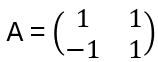
has no eigenvalues in R, 1+i and 1-i. For any (nxn)-matrix A over C, det (A – λ I) can be completely factored on C, so A has n eigenvalues and n corresponding eigenvectors
A is diagonizable if a matrix V exists, so that D = V-1AV; this corresponds to a change of basis vectors: D represents the same linear transformation as A but in a different basis
Now a complex matrix is diagonizable if all its eigenvalues are different (in case of repeated eigenvalues it may still be possible, but not in general)
Spectral theorem: A nxn complex matrix A is Hermitian if

Then all eigenvalues of A are real and the corresponding eigenvectors build an orthogonal basis of Cn
Be U a complex unitary matrix: U = V+DV with V and D unitary. Since V+=V-1: VU+V = D. In other words: there is a unitary change of basis so that U is diagonal
Note: Solving the eigenvalue problem in quantum mechanics means finding the state (eigenfunction/-vector) the particle can occupy and the physical quantities (eigenvalues) it can possess in that state
f) Tensorproduct
V, W are two finite dimensional vector spaces: V ⨂ W is generated by addition and scalar multiplication of all formal objects v ⨂ w for each v in V and w in W
If {v1,…vn} and {w1,…,wn} are bases for V and W, then {v1 ⨂ w1, …, vn ⨂ wm} are basis vectors of V ⨂ W
X, Y are two additional vector spaces, if f: V -> X and g: W -> Y are linear mappings, then so is
f ⨂ g: V ⨂W -> X ⨂ Y with (f ⨂ g)(v ⨂ w) = f(v) ⨂ g(w)
For 2×2 matrices:
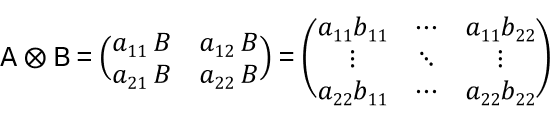
For vectors: v = (v1,v2,v3), w = (w1, w2): v ⨂ w = (v1w1,v1w2, …,v3w2)
For R2 ⨂ R2 or C2 ⨂ C2: e1 ⨂ e1 = (1,0) ⨂ (1,0) = (1,0,0,0), … , e2 ⨂ e2 = (0,0,0,1). Note: C2 ⨂ C2 ⨂ C2 has dimension 23
g) Root of Unity & Summation Formula
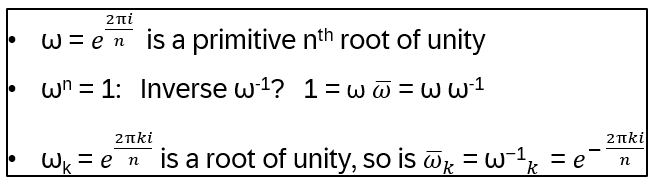
n in N, then the nth root of unity is ω in C with ωn=1. There are n nth roots of unity and 1 is always one of them.
ω is a primitive nth root of unity, if every other root of unity can be written as ωk for some k in N
Example: all roots of unity for n = 3?
n = 1: One first root of unity, 1
n = 2: Two second roots of unity, 1 and -1
n = 3: With Euler’s formula eφi = cos(φ) + sin(φ)i, |eφi| = 1 (note that φ = 2π/3 is a 1/3 rotation around the unit circle), third roots of unity:


Because 3 is prime, ω is primitive:

In general:
Now:
xn – 1 = (x-1) (xn-1 + xn-2 + … + x + 1)
For every nth root of unity: xn – 1 = 0 , hence from the above
x = ω = 1 and for ω ≠ 1:

With

(adding the same set of roots in a different order!)
With the Kronecker delta function δj,k = 0 if j ≠ k and 1 if j = k:
Extended summation formula:

3. One Qubit
a) Bloch Sphere
A classical bit is 0 or 1 and only in one of those states at any given time!
Qubit representation on the Bloch sphere:
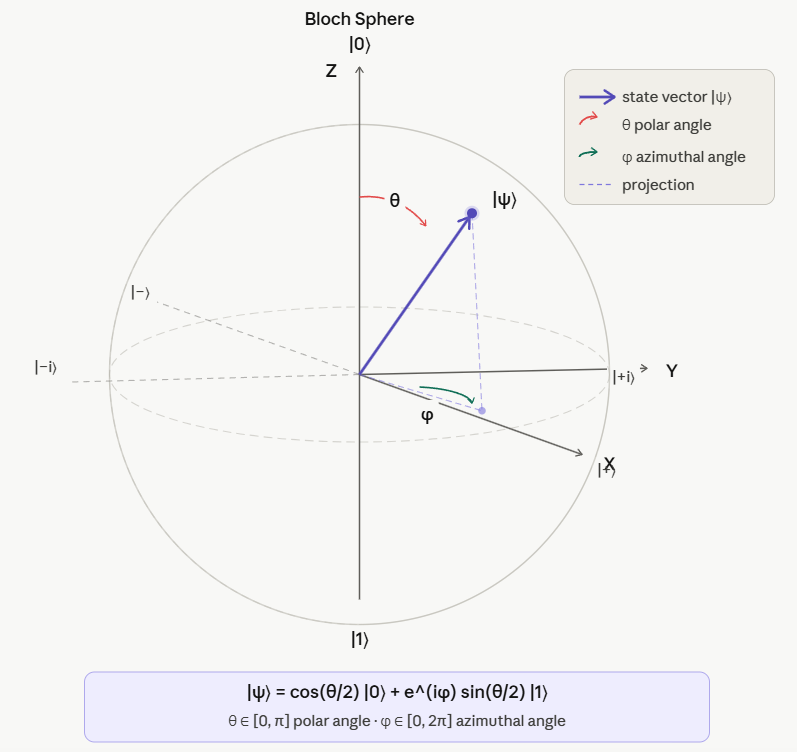
When measured, a qubit is always in states |0> or |1>, but during computing it can be in any (quantum) state on the sphere!
Formally: the qubit is in superposition of |0> and |1> in C2 ,
|ψ> = a |0> + b |1>
with |a|2 + |b|2 = 1 (unit sphere), where a, b are probability amplitudes
Because qubits are not ‘independent’ to each other as classical bits (superposition of quantum states), huge parallelism is possible.
A single computation acting on 300 qubits can achieve the same effect as 2300 simultaneous computations acting on classical bits!
b) Quantum Mechanics Notification: Bra and Kets
What are |0> and |1>?
For a vector v, write bra

and for w, ket
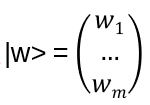
Then for example:
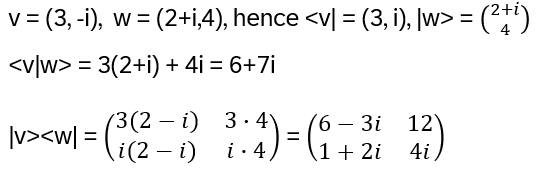
|0> and |1> build the standard orthonormal basis for C2: |0> = (1,0) = e1, |1> = (0,1) = e2 . Other orthonormal basises are

and

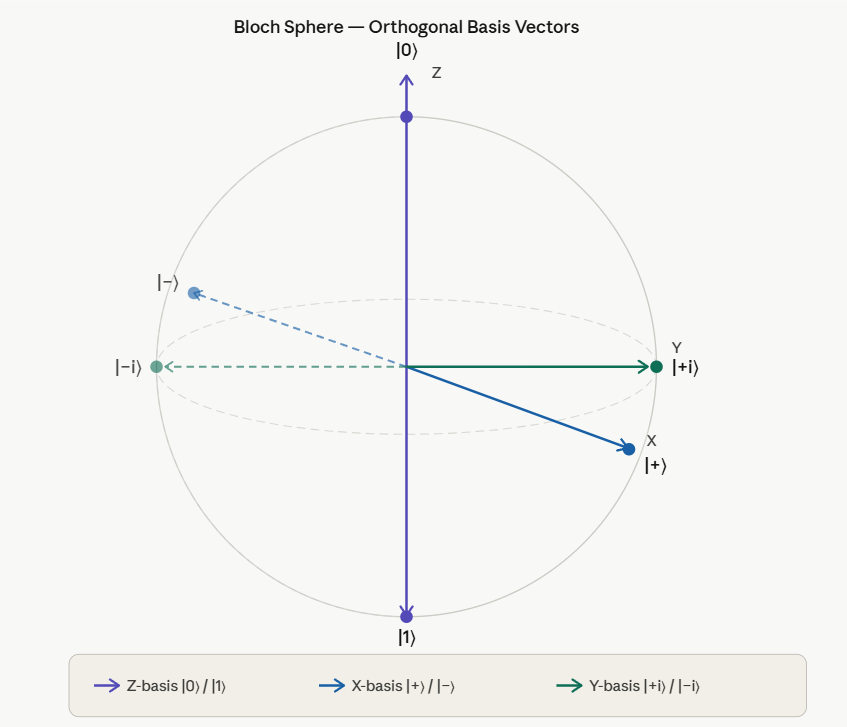
A qubit state has length 1, and any linear transformation must preserve this length! Hence all matrix representations of such transformations are unitary (and hence invertible).
See later for ‘quantum circuits’: all ‘gates’ (operations = linear transformations) are reversible! Only the measurement operation is not! In other words: a quantum circuit is applying unitary matrices to vectors, representing qubit states
c) Quantum State of a Qubit
Quantum state: |ψ> = a |0> + b |1> with ||ψ|| = < ψ | ψ >2 = 1
|ψ> = a |0> + b |1> = r1 eφ’i |0> + r2 eφ’’i |1> = eφ’i (r1 |0> + r2 e(φ’-φ’’)i |1>
Multiplying |ψ> by a phase eφ’i doesn’t change it in the sense that the probability of obtaining |0> or |1> is not changed, i.e. there is no observable difference! Hence there are two degrees of freedom for a qubit:
1)Magnitudes r1, r2 with r12+r22 = 1
2)Relative phase φ = φ1 – φ2
|ψ> of a single qubit is therefore |ψ> = r1 |0> + r2 eφi |1> with r1, r2 in R, r12+r22 = 1, 0 ≤ φ < 2π
d) Observables and Expectations
Measurement of a quantum system:
- The measurement of a specific observable can be represented by a unitary operator U (matrix)
- The quantum system is described by a Hilbert-Vector |ψ>
- A measurement is the application of U to |ψ>
- Results of the measurement are Eigenvalues ui of U
- Probability for a specific ui: | <ui| ψ> |2
Let M0 = |0><0| , M1 = |1><1| , |ψ> = a |0> + b |1>
< ψ| M0 | ψ> = |a|2 probability for |0>
< ψ| M1 | ψ> = |b|2 probability for |1>
M0 and M1 are observables! The ‘expectation’ <A> of an observable A given the state | ψ> is < ψ| A| ψ>
e) Quantum Gates
Remember: The matrices corresponding to gates/operations on qubits are all unitary!
Examples:
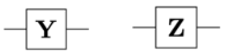
Quantum X Gate
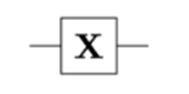
corresponds to the Pauli matrix
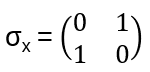
σx |0> = |1> , σx 1> = |0>, i.e. the ‘not’ gate
Bloch sphere: a quantum state is rotated around the x-axis by π. Rotation around the y-axis σy , around the z-axis σz
Hadamard Gate

H changes the basis from |0>, |1> to |+>, |->
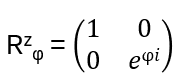
The Quantum Rzφ Gates: generalize σz to
and define

Then: S|0> = |0>, S|1> = e(π /2)i |1> = i |1>, |1> is an eigenvector of S with eigenvalue i
4. Two Qubits
a) Entanglement
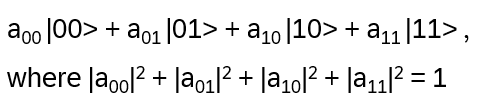
2 qubits q1, q2 are in superposition states represented in C2 ⨂ C2 by a linear combination of |00>, |01>, |10>, |11> (corresponds to 4 possible outcomes of measurement, since each qubit will drop to |0> or |1>)
and e.g.
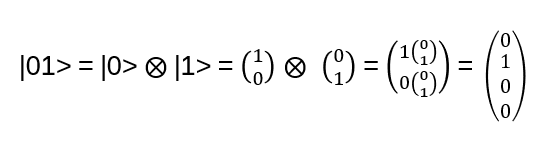
Through measurement the qubits are irreversible projected to |00>, |01>, |10> or |11> with probability |a00|2 , |a01|2 , |a10|2 , |a11|2 respectively. Entanglement is one of the main differences to classical computing! Why? Let’s do an example of Entanglement:
Let q1, q2 be in the state

i.e. when measured (very often) it will be half of the time in |01> and half of the time in |10>, but never in |00> or |11>
Now measure q2 only and let’s say the result is |1>. This can come only from |01> or |11>, but |11> is impossible, hence q1 must be |0>! This is ENTANGLEMENT
A 2-bit quantum state |ψ> in C2 ⨂ C2 is entangled if and only if it cannot be written as a tensor of two 1-qubit kets: If

then |ψ> is not entangled
For the example above: assume it is entangled, then there are a1, b1, a2, b2 in C, with
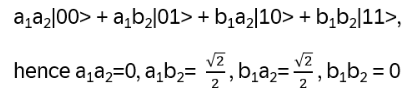
Hence:

-> assumption not correct!
This can be generalized to n-qubit systems with states having 2n dimensions and the state space can be written as (C2)⨂ n
b) Multi-Qubit Gates: The Quantum H⨂ n Gate
For 2 qubits, quantum gate operations are 4×4 unitary square matrices (for 10 qubits: 210x210 matrices). 2 Examples:
First the quantum H⨂ n gate
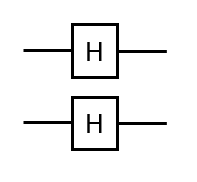
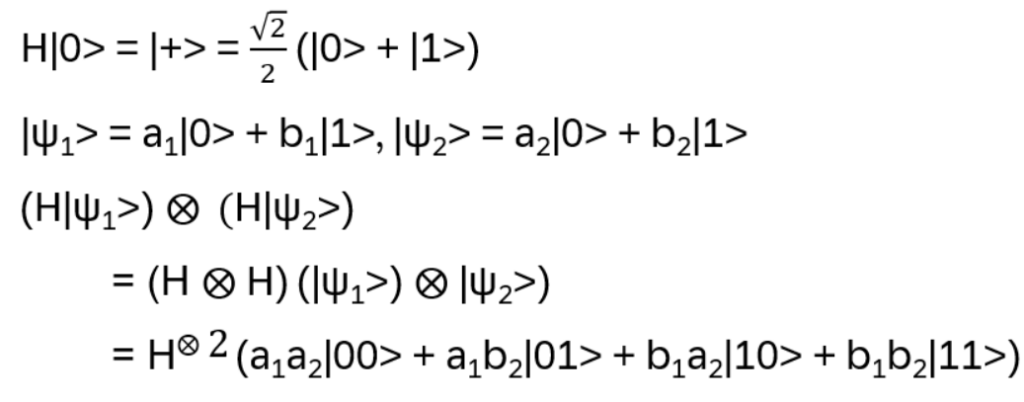
with
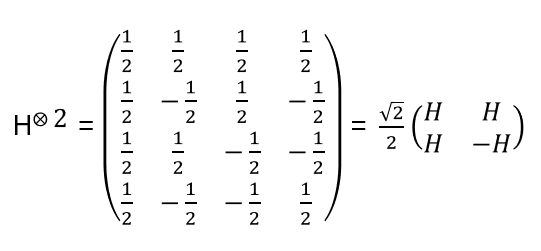
This matrix puts both initialized qubits into a balanced (equal amplitudes) superposition!
Notation: the set of n-qubits for (C2)⨂n composed of only 0s and 1s are called computational bases. E.g. for C2 ⨂ C2 ⨂ C2 |000>, |001>, |010>, |011>, |100>, |101>, |110>, |111>. These are the same as |0>3 |1>3 |2>3 |3>3 |4>3 |5>3 |6>3 |7>3
For 3-qubits:
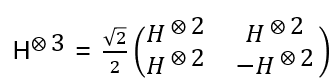

with

beeing a normalization constant
Classical: three bits have 23 states, but only one at a time. The 3-qubit state H⨂3|0>3 contains all 8 possible basis kets at the same time!
c) The quantum CNOT or CX gate
Now the second gate:
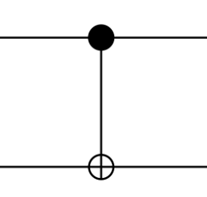
This gate creates entangled qubits (!), ‘C’ stands for ‘CONTROLLED’ (black dot, control qubit; the other: target)
Two input states |ψ1>, |ψ2> and hence two outputs (reversable):
• if |ψ1> = |1> -> output: |ψ1>, X|ψ2>
• if |ψ1> = |0> -> output: |ψ1>, |ψ2>
Example:
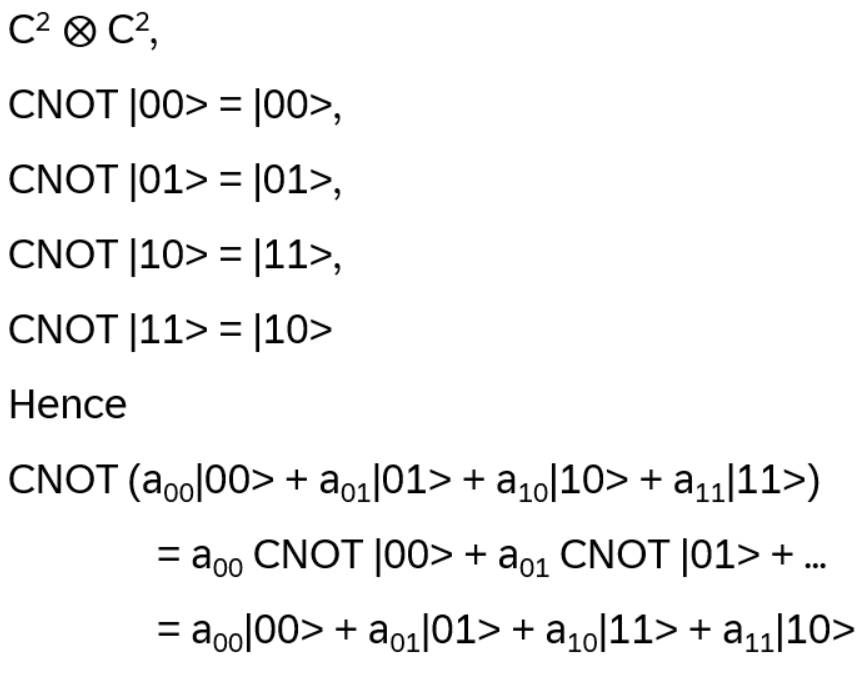
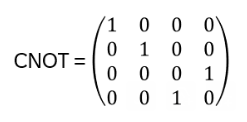
Eigenvalues and Eigenstates of CNOT:
Eigenstates of the Pauli X (bit-flip) operator in the |0>, |1> basis (also called Z basis):
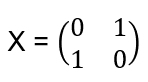
To find the eigenvalues: det(X−λI)=0

Eigenvectors, ∣ψ> = a|0> + b|1>
i) λ = +1: (X−I) ∣ψ> = 0, hence a = b; normalizing:
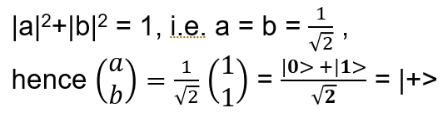
ii) λ = -1: (X+I) ∣ψ> = 0, hence a = -b; normalizing:
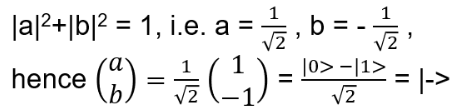
Behavior X operator:
• X|+⟩ = +|+⟩ (unchanged)
• X|−⟩ = −|−⟩ (phase flip)
• X|0⟩ = |1⟩ (bit flip)
• X|1⟩ = |0⟩ (bit flip)
Note: ∣+> = H∣0> and ∣−> = H∣1>, and in addition
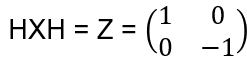
i.e. H rotates the eigenstates of X onto the eigenstates of Z; |+>, |-> is also referred as X basis
5. Circuits
a) Simple Circuits
Quantum register: a collection of qubits used for computation, all qubits in a register are initialized to |0>
Quantum circuit: a sequence of gates applied to one or more qubits in a quantum register
Simple circuits:
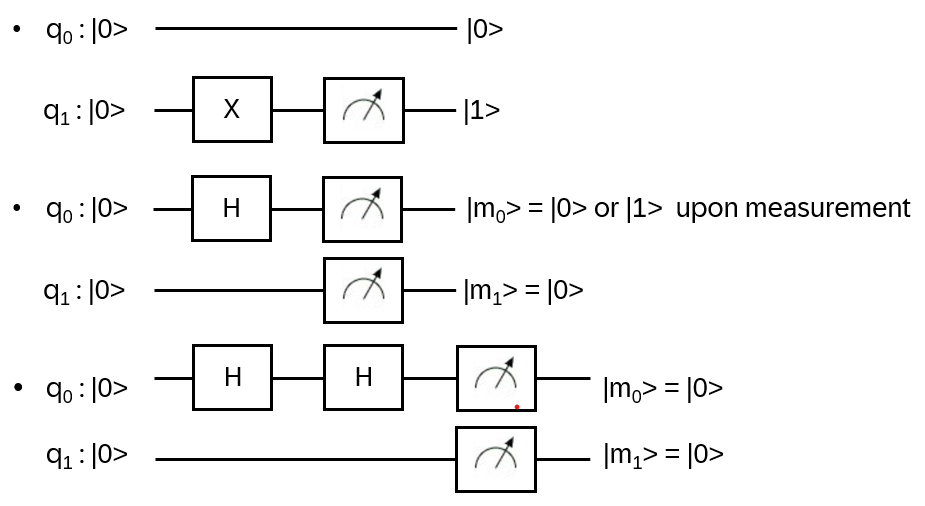
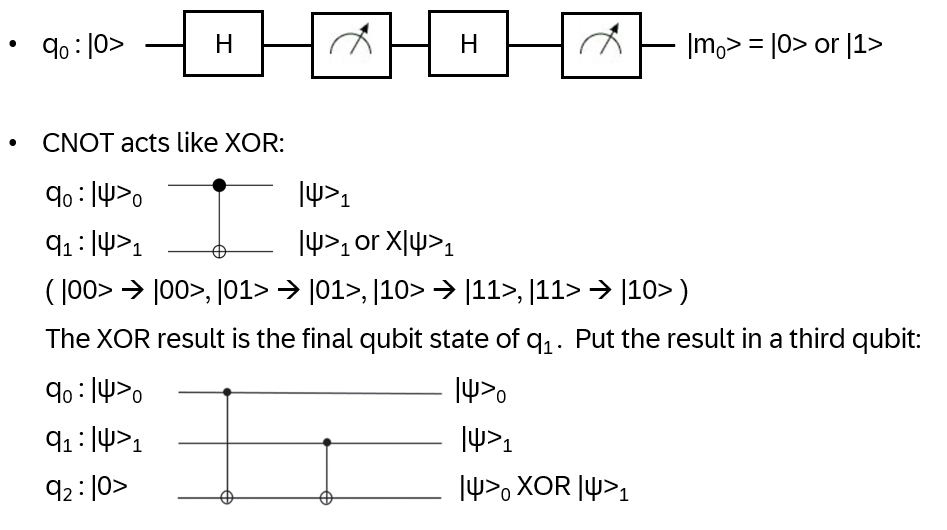
Note: there is no CLONE gate that can duplicate the quantum state of a qubit! (No backups for qubits!)
b) Amplitude Maximization & Interference
3-qubit quantum register state:
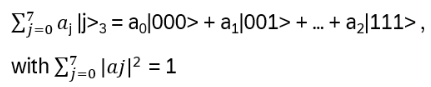
Balanced superposition (all coefficients are equal):

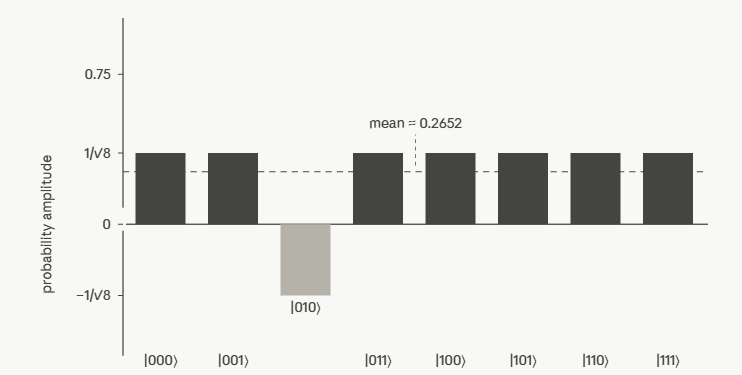
Let’s assume one of the basis kets is the solution to some problem. Possibility of an amplitude amplification for that ket? For a quantum algorithm in general: have the results of the final qubit measurements to correspond with high probability to the best solution
How? First: flip the sign of the ket in question (e.g. |010> by U|010> being I8 except that the (3,3) entry is -1)
c) Inversion about the mean
Next: inversion about the mean
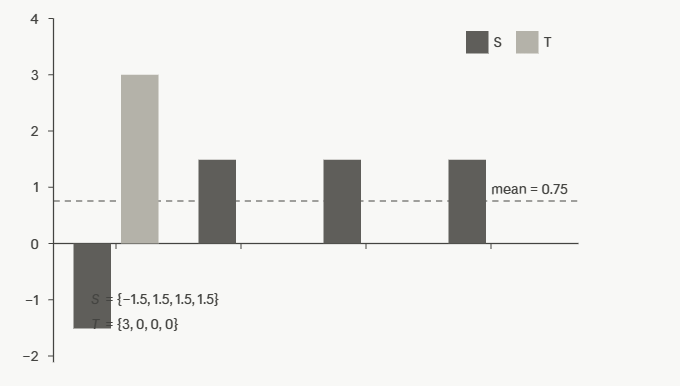
S = {sj} finite in R, m the mean of those numbers. Create T = {tj = 2m – sj}. Then it holds:
•The mean is still m
•The mapping is reversible
•Sj=m , then tj = sj = m
•Tj – m = m –sj
•Sj < m: tj > m , and sj > m: tj < m
Example: S = {-1,5; 1,5; 1,5; 1,5} -> m = 0,75, T = {3; 0; 0; 0}
Now back to |φ> = H⨂ 3 |000>; define

Then Uφ performs an inversion about the mean!
Negating the amplitude and applying Uφ multiple times leads to an increase of the desired probability
But: one can’t apply those two steps too many times, because at some point the desired amplitude is decreasing and the others are increasing again!
Note:
• How many times to maximize the probability? Approximation:

• Generalization of Uφ: Groover diffusion operator
H⨂ n( 2 |0>⨂n <0|⨂n – I⨂ n )H⨂n
In this context often used:
Oracle function for some question := black box resulting in 1 for yes and 0 for no; oracles cannot answer random questions, they respond to specific queries.
For classical data: f:{0,1}n -> {0,1}; for quantum computing for basis kets it could be e.g. f(|x>i) = |1> for one special |x>i, |0> otherwise. f can be represented by a unitary operator Uf (see the blog about Simon’s Algorithm for an detailed example of how an oracle is working)
6. Sources
[1] ‚Polynomial-Time Algorithms for Prime Factorization and Discrete Logarithms on a Quantum Computer‘ by Shor, 1995 (https://www.arxiv.org/abs/quant-ph/9508027)
[2] ‚Migration-to-post-quantum-cryptography-WhitePaper‚ by Mastercard, 2025
[3] ‚Multi-objective optimization offers bold new path to quantum advantage‘ by Woerner et al. (IBM Quantum Blog), 2026(https://www.ibm.com/quantum/blog/multi-objective-optimization)
[4] Lineare Algebra, Gerd Fischer, vieweg studium, 9. Aufl. 1989
[5] Vorlesungen über Physik, Band III: Quantenmechanik, Feynman/Leighton/Sands, Oldenbourg, 2.Aufl. 1992
‚Dancing with Qubits‘, R.S. Sutor, <packt>, second edition, 2024
Schreibe einen Kommentar